What is website AEO semantic SEO?
In today’s digital world, search engines are no longer just matching exact keywords. They try to understand meaning, intent, and context. This is where semantic SEO and AEO come in.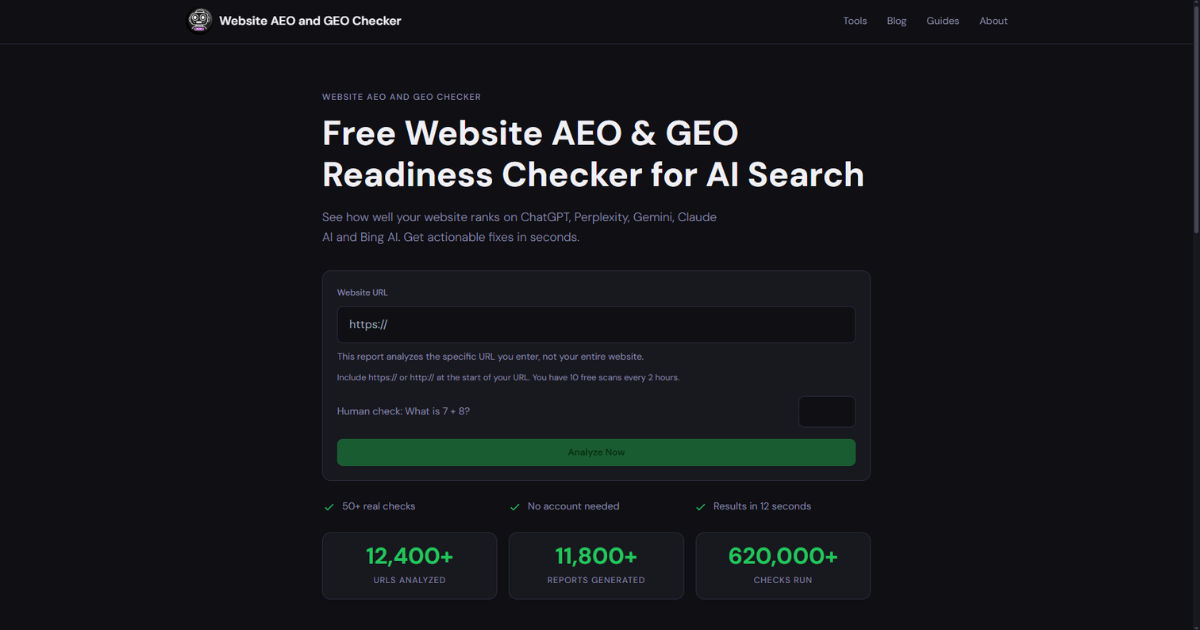
Modern content optimization also involves tools like Website AEO and GEO Checker, which help analyze how well a page is optimized for answer engines and generative search systems.
Website AEO and GEO Checker tools are becoming important because search engines like Google, Bing, and AI-powered assistants now focus on direct answers rather than just ranking pages based on keywords.
To understand this properly, we need to break down three main concepts:
- AEO (Answer Engine Optimization)
- Semantic SEO
- GEO (Generative Engine Optimization)
Let’s explore each step by step in a simple way.
What is AEO (Answer Engine Optimization)?
AEO stands for Answer Engine Optimization. It is the process of optimizing content so that it directly answers user questions.
Instead of just ranking on Google search results, AEO focuses on appearing in:
- Featured snippets
- Voice search answers
- AI-generated responses
- “People also ask” sections
For example, if someone asks:
“What is semantic SEO?”
An AEO-optimized page will provide a direct, clear answer within the content.
This is why tools like Website AEO and GEO Checker are used to evaluate whether content is structured in a way that search engines can easily extract answers.
Why AEO is Important
AEO is important because:
- Users prefer quick answers
- Voice assistants rely on direct responses
- AI tools extract structured content
- Featured snippets drive high traffic
If your content is not optimized for AEO, it may still rank, but it will miss out on high-visibility answer placements.
What is Semantic SEO?
Semantic SEO is the practice of optimizing content based on meaning rather than just keywords.
Instead of repeating a keyword multiple times, semantic SEO focuses on:
- Related terms
- Context
- User intent
- Topic depth
For example, if your topic is “digital marketing,” semantic SEO includes related concepts like:
- SEO strategy
- Content marketing
- Search intent
- Backlinks
- Keyword research
This helps search engines understand the full topic, not just individual words.
How Semantic SEO Works
Search engines like Google use natural language processing (NLP) to understand content. They analyze:
- Word relationships
- Context of sentences
- User behavior
- Topic clusters
So instead of ranking pages just for keywords, they rank pages that fully cover a topic.
This is where semantic SEO becomes powerful.
Relationship Between AEO and Semantic SEO
AEO and semantic SEO work together.
- Semantic SEO builds topic depth
- AEO extracts direct answers from that content
When combined, they help your content appear in both traditional search results and AI-generated answers.
For example:
- Semantic SEO ensures your article covers “What is SEO?” in detail
- AEO ensures a short, clear definition is available for AI tools
This combination improves visibility across multiple search platforms.
What is GEO (Generative Engine Optimization)?
GEO stands for Generative Engine Optimization. It is a newer concept that focuses on optimizing content for AI systems like:
- ChatGPT-style assistants
- Google SGE (Search Generative Experience)
- Bing AI search
These systems do not just show links. They generate answers.
So GEO is about making sure your content is:
- Easy for AI to understand
- Structurally clear
- Factually reliable
- Well-organized
Tools like Website AEO and GEO Checker help evaluate whether your content is suitable for generative AI systems.
How Website AEO and GEO Checker Tools Work
A Website AEO and GEO Checker tool analyzes your website content to see how well it performs in modern search systems.
It usually checks:
Content Structure
- Headings and subheadings
- Paragraph clarity
- Logical flow
Answer Quality
- Does it directly answer questions?
- Are definitions clear?
- Is information complete?
Semantic Coverage
- Related keywords
- Topic relevance
- Contextual depth
AI Readiness
- Can AI extract summaries easily?
- Is content structured logically?
These checks help website owners improve visibility in both search engines and AI tools.
Why Semantic SEO is More Important Than Keyword SEO
Old SEO strategies focused heavily on keyword repetition. But modern search engines are smarter.
They now understand:
- Synonyms
- Context
- Intent
- Topic relationships
This means keyword stuffing no longer works.
Instead, semantic SEO ensures:
- Better ranking stability
- Higher content quality
- Improved user experience
- More organic traffic
For example, instead of repeating “best shoes” 20 times, semantic SEO would include:
- running shoes
- footwear guide
- sneaker reviews
- comfort shoes
This makes content more natural and useful.
How to Optimize Content for AEO and Semantic SEO
To optimize properly, follow these steps:
Focus on User Questions
Think about what users actually ask, such as:
- What is it?
- How does it work?
- Why is it important?
Then answer them clearly.
Use Structured Headings
Break content into sections like:
- Definitions
- Benefits
- Examples
- Step-by-step guides
This helps both users and search engines.
Write Simple and Clear Sentences
Avoid overly complex language. A 12th-grade reading level is ideal for clarity and reach.
Include Related Topics
Cover subtopics naturally instead of repeating the same keyword.
Optimize for AI Extraction
Make sure each section can stand alone as an answer.
Common Mistakes in Semantic SEO and AEO
Many beginners make mistakes such as:
Keyword Stuffing
Repeating the same phrase too often reduces readability and SEO performance.
Ignoring User Intent
Writing content without understanding what users actually want.
Poor Structure
Long paragraphs without headings make content hard to scan.
Over-Optimization
Trying too hard to please algorithms instead of humans.
Avoiding these mistakes improves both rankings and engagement.
Future of AEO, Semantic SEO, and GEO
Search engines are evolving rapidly. In the future:
- AI will dominate search results
- Direct answers will replace traditional links
- Content will be judged by clarity and usefulness
- Semantic understanding will become essential
This means websites must adapt or lose visibility.
Tools like Website AEO and GEO Checker will become standard in content optimization workflows.
Practical Example of Semantic SEO + AEO
Let’s say you write an article about “healthy diet.”
Instead of writing:
“Healthy diet is important. Healthy diet helps you stay healthy.”
You would write:
“A healthy diet improves energy levels, supports immune function, and reduces the risk of chronic diseases.”
Then AEO optimization would add:
“A healthy diet is a balanced eating pattern that provides essential nutrients your body needs.”
This structure helps both readers and AI systems.
Benefits of Using Semantic SEO with AEO
Combining both strategies gives multiple advantages:
- Higher search rankings
- More featured snippets
- Better AI visibility
- Increased organic traffic
- Stronger topical authority
This is why modern SEO is shifting toward meaning-based optimization.
Conclusion
Website optimization has evolved beyond simple keyword placement. Today, success depends on understanding meaning, intent, and structure.
Semantic SEO helps search engines understand your content deeply, while AEO ensures your content is ready to answer user questions directly. GEO takes this further by preparing content for AI-driven search systems.
In this environment, tools like Website AEO and GEO Checker become extremely useful for analyzing and improving content performance across both traditional and AI search platforms.
If you want to stay competitive in digital marketing, focusing on semantic SEO and AEO is no longer optional—it is essential. Websites that adapt early will gain a strong advantage in visibility, traffic, and authority.
 In simple terms, a POS for restaurant acts like the brain of the restaurant, connecting the kitchen, billing counter, and customer service into one smooth system.